پاکستان میں تحفظِ عقیدۂ ختمِ نبوت کے مروجہ مناہج اور آئین و قانون سازی: ایک تنقیدی و تجزیاتی مطالعہ
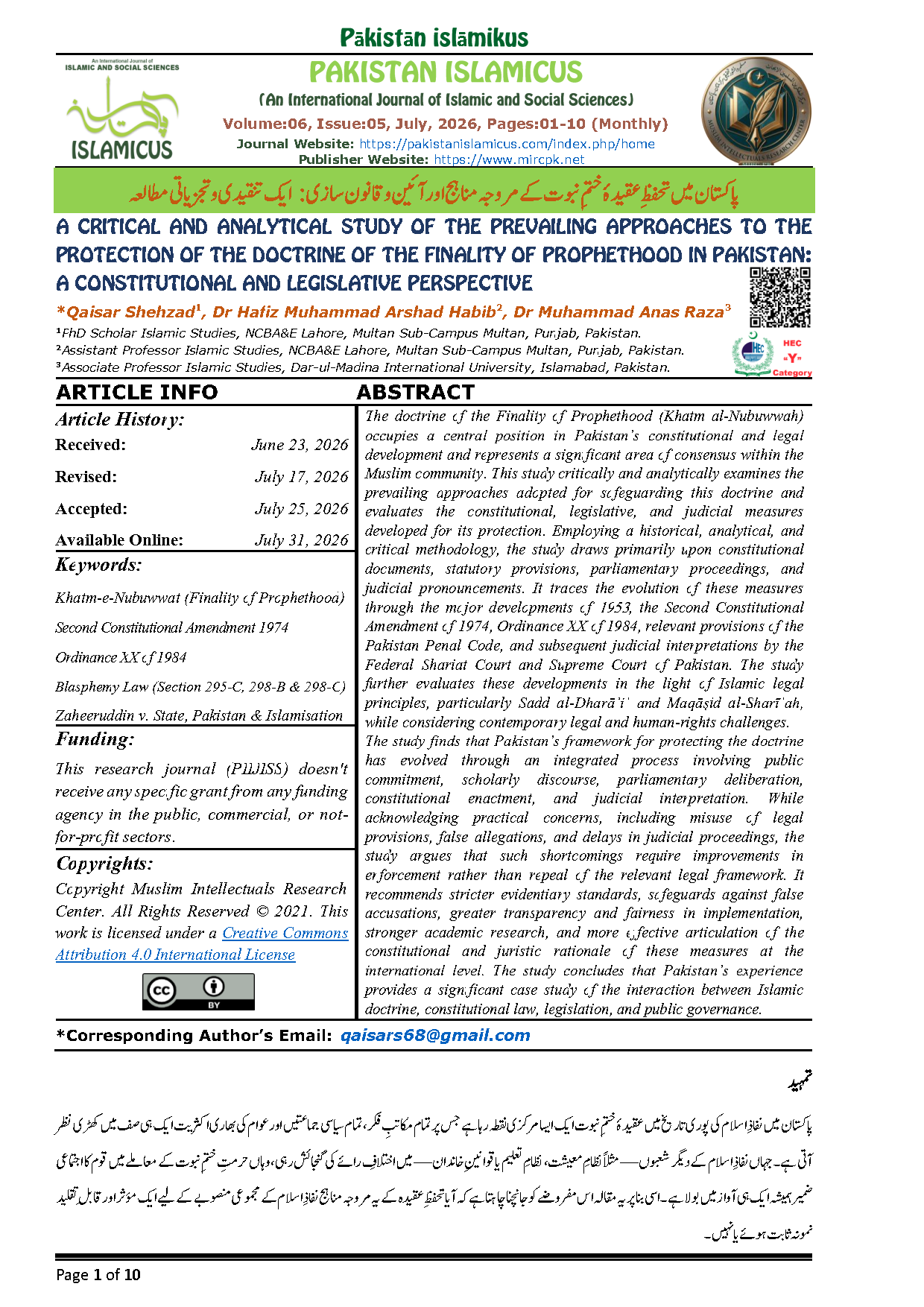
A CRITICAL AND ANALYTICAL STUDY OF THE PREVAILING APPROACHES TO THE PROTECTION OF THE DOCTRINE OF THE FINALITY OF PROPHETHOOD IN PAKISTAN: A CONSTITUTIONAL AND LEGISLATIVE PERSPECTIVE
Keywords:
Khatm-e-Nubuwwat (Finality of Prophethood); Second Constitutional Amendment 1974; Ordinance XX of 1984; Blasphemy Law (Section 295-C, 298-B & 298-C); Zaheeruddin v. State, Pakistan & Islamisation.Abstract
The doctrine of the Finality of Prophethood (Khatm al-Nubuwwah) occupies a central position in Pakistan’s constitutional and legal development and represents a significant area of consensus within the Muslim community. This study critically and analytically examines the prevailing approaches adopted for safeguarding this doctrine and evaluates the constitutional, legislative, and judicial measures developed for its protection. Employing a historical, analytical, and critical methodology, the study draws primarily upon constitutional documents, statutory provisions, parliamentary proceedings, and judicial pronouncements. It traces the evolution of these measures through the major developments of 1953, the Second Constitutional Amendment of 1974, Ordinance XX of 1984, relevant provisions of the Pakistan Penal Code, and subsequent judicial interpretations by the Federal Shariat Court and Supreme Court of Pakistan. The study further evaluates these developments in the light of Islamic legal principles, particularly Sadd al-Dharāʾiʿ and Maqāṣid al-Sharīʿah, while considering contemporary legal and human-rights challenges.
The study finds that Pakistan’s framework for protecting the doctrine has evolved through an integrated process involving public commitment, scholarly discourse, parliamentary deliberation, constitutional enactment, and judicial interpretation. While acknowledging practical concerns, including misuse of legal provisions, false allegations, and delays in judicial proceedings, the study argues that such shortcomings require improvements in enforcement rather than repeal of the relevant legal framework. It recommends stricter evidentiary standards, safeguards against false accusations, greater transparency and fairness in implementation, stronger academic research, and more effective articulation of the constitutional and juristic rationale of these measures at the international level. The study concludes that Pakistan’s experience provides a significant case study of the interaction between Islamic doctrine, constitutional law, legislation, and public governance.
Downloads
References
Al-Qur’ān. Sūrat al-Aḥzāb, 33:40.
Al-Bukhārī, Muḥammad ibn Ismā‘īl. (n.d.). Al-Jāmi‘ al-Ṣaḥīḥ, Kitāb al-Manāqib, Bāb Khātam al-Nabiyyīn (Ḥadīth 3535). Bayrūt: Dār Ibn Kathīr.
Iqbāl, Muḥammad. (1936). Islam and Ahmadism (pp. 5–9). Lāhaur: Anjuman Khuddām-i-Dīn.
Hukūmat-i-Punjāb. (1954). Report of the Court of Inquiry constituted under Punjab Act II of 1954 to enquire into the Punjab Disturbances of 1953 (pp. 1–14). Lāhaur: Superintendent, Government Printing.
Hukūmat-i-Punjāb. (1954). Report of the Court of Inquiry constituted under Punjab Act II of 1954 to enquire into the Punjab Disturbances of 1953 (pp. 215–218).
Qādir, Sayyid ‘Abd al-. (1994). Taḥrīk-i-Khatm-i-Nubuwwat kī mukhtaṣar tārīkh. Lāhaur: Majlis-i-Aḥrār-i-Islām.
Naṣr, Sayyid Vali Reza. (2001). The Islamic Leviathan: Islam and the Making of State Power (pp. 96–104). New York: Oxford University Press.
Mawdūdī, Abū al-A‘lā. (1979). Qādiyānī mas’alah (Ṭab‘ Jadīd, pp. 7–24). Lāhaur: Islamic Publications.
Iqbāl, Mujāhid. (2008). Taḥrīk-i-Khatm-i-Nubuwwat aur ṣaḥāfat. Lāhaur: Idārah Ma‘ārif-i-Islāmī.
National Assembly of Pakistan. (1974). Proceedings of the Special Committee of the Whole House Held in Camera to Consider the Qadiani Issue (Vol. I, pp. 1–6). Islamabad: National Assembly Secretariat.
National Assembly of Pakistan. (1974). Proceedings of the Special Committee of the Whole House Held in Camera to Consider the Qadiani Issue (Vol. III, pp. 1421–1560).
Khālid, Muḥammad Matīn. (2005). Taḥrīk-i-Khatm-i-Nubuwwat 1974: Qaumī Assembly kī kārwā’ī kā tajziyah. Lāhaur: ‘Ilm-o-‘Irfān Publishers.
Aḥmad, Sa‘īd. (2010). Muftī Maḥmūd: Ḥayāt-o-Khadamāt. Lāhaur: Idārah Ta’līfāt Ashrafiyyah.
Constitution (Second Amendment) Act, 1974 (Act No. XLIX of 1974); The Constitution of the Islamic Republic of Pakistan, Article 260(3).
The Constitution of the Islamic Republic of Pakistan, Article 260(3)(a)–(b).
Anti-Islamic Activities of Quadiani Group, Lahori Group and Ahmadis (Prohibition and Punishment) Ordinance, 1984 (Ordinance No. XX of 1984), Gazette of Pakistan, Extraordinary, April 26, 1984.
Al-Shāṭibī, Abū Isḥāq. (n.d.). Al-Muwāfaqāt fī Uṣūl al-Sharī‘ah (Taḥqīq: ‘Abd Allāh Darāz, Vol. 4, pp. 198–202). Bayrūt: Dār al-Ma‘rifah.
Pakistan Penal Code (Act XLV of 1860), Section 298-B, as inserted by Ordinance XX of 1984.
Kennedy, Charles H. (1989). Towards the definition of a Muslim in an Islamic state: The case of the Ahmadiyya in Pakistan. In Dhirendra Vajpeyi & Yogendra Malik (Eds.), Religious and Ethnic Minority Politics in South Asia (pp. 71–108). New Delhi: Manohar.
Pakistan Penal Code (Act XLV of 1860), Section 298-C, as inserted by Ordinance XX of 1984.
Pakistan Penal Code (Act XLV of 1860), Section 295-C, as inserted by the Criminal Law (Amendment) Act, 1986 (Act III of 1986).
Quraishī, Muḥammad Ismā‘īl. (1994). Nāmūs-i-Risālat aur qānūn-i-tauhīn-i-risālat (pp. 145–178). Lāhaur: Al-Manbar Publications.
Mujibur Rahman v. Government of Pakistan, PLD 1985 FSC 8.
Zaheeruddin v. State, 1993 SCMR 1718.
The Role of Islam in the Legal System of Pakistan. (2006). Leiden: Martinus Nijhoff.
Nasr, Seyyed Vali Reza. (2001). The Islamic Leviathan: Islam and the Making of State Power (p. 144). New York: Oxford University Press.
Siddique, Osama, & Khan, Zahra. (2005). Enforced apostasy: Zaheeruddin v. State and the official persecution of the Ahmadiyya community in Pakistan. Law & Social Inquiry, 30(2), 275–294.
Downloads
Published
Issue
Section
License
Copyright (c) 2026 PAKISTAN ISLAMICUS (An International Journal of Islamic & Social Sciences)

This work is licensed under a Creative Commons Attribution 4.0 International License.
This work is licensed under a Creative Commons Attribution 4.0 International License.