عصر حاضر کے طبعی مسائل میں اجتہادی ارتقاء؛ انتقالِ خون، اعضاء کی پیوندکاری اور ویکسین کے فقہی احکام کا تجزیاتی مطالعہ
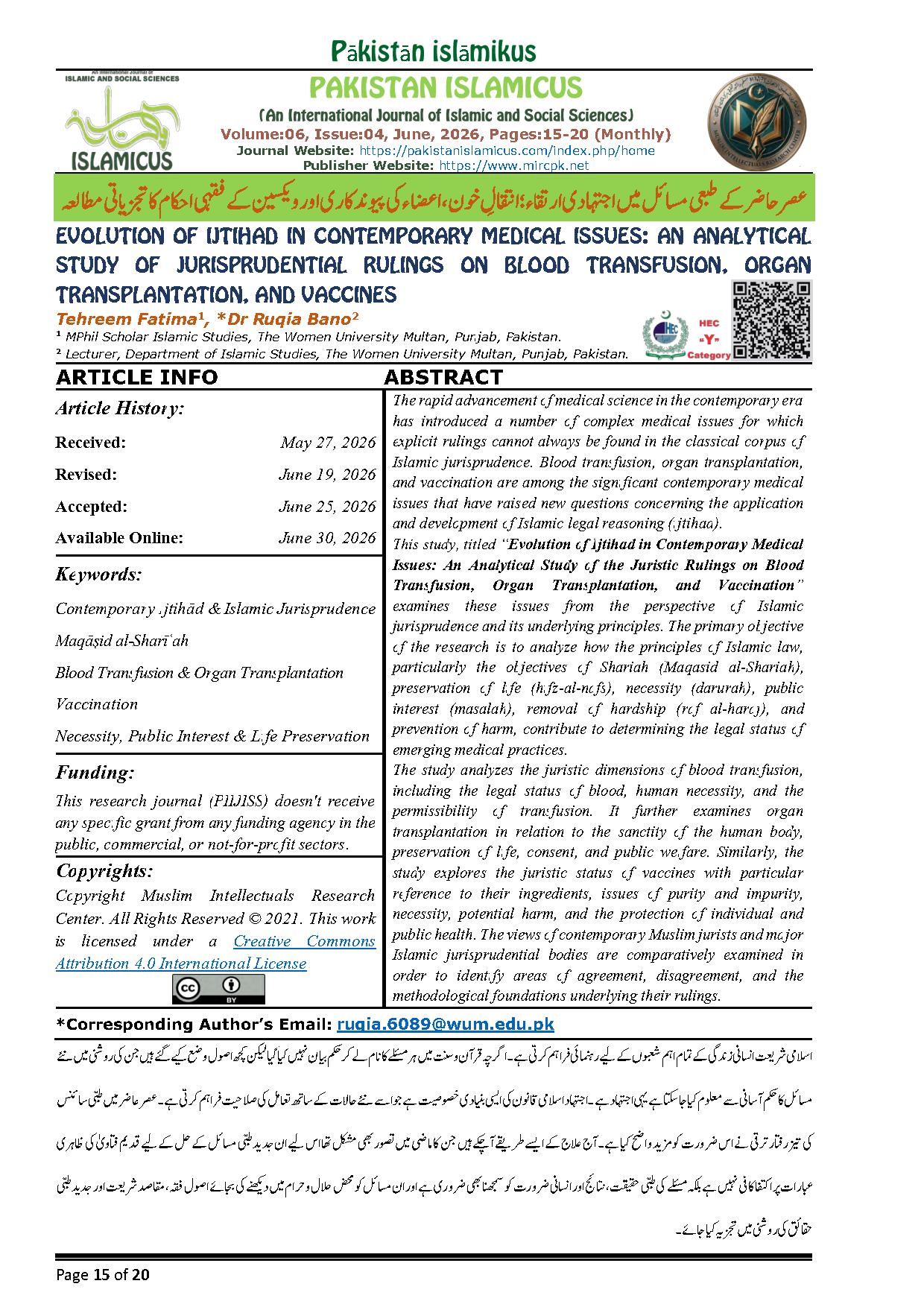
EVOLUTION OF IJTIHAD IN CONTEMPORARY MEDICAL ISSUES: AN ANALYTICAL STUDY OF JURISPRUDENTIAL RULINGS ON BLOOD TRANSFUSION, ORGAN TRANSPLANTATION, AND VACCINES
Keywords:
Contemporary Ijtihād & Islamic Jurisprudence, Maqāṣid al-Sharīʿah, Blood Transfusion & Organ Transplantation, Vaccination, Public Interest & Life Preservation.Abstract
The rapid advancement of medical science in the contemporary era has introduced a number of complex medical issues for which explicit rulings cannot always be found in the classical corpus of Islamic jurisprudence. Blood transfusion, organ transplantation, and vaccination are among the significant contemporary medical issues that have raised new questions concerning the application and development of Islamic legal reasoning (ijtihad).
This study, titled “Evolution of Ijtihad in Contemporary Medical Issues: An Analytical Study of the Juristic Rulings on Blood Transfusion, Organ Transplantation, and Vaccination” examines these issues from the perspective of Islamic jurisprudence and its underlying principles. The primary objective of the research is to analyze how the principles of Islamic law, particularly the objectives of Shariah (Maqasid al-Shariah), preservation of life (hifz-al-nafs), necessity (darurah), public interest (masalah), removal of hardship (raf al-haraj), and prevention of harm, contribute to determining the legal status of emerging medical practices.
The study analyzes the juristic dimensions of blood transfusion, including the legal status of blood, human necessity, and the permissibility of transfusion. It further examines organ transplantation in relation to the sanctity of the human body, preservation of life, consent, and public welfare. Similarly, the study explores the juristic status of vaccines with particular reference to their ingredients, issues of purity and impurity, necessity, potential harm, and the protection of individual and public health. The views of contemporary Muslim jurists and major Islamic jurisprudential bodies are comparatively examined in order to identify areas of agreement, disagreement, and the methodological foundations underlying their rulings.
Downloads
References
Al-Qur’ān, 29:69
Al-Qur’ān, 05:03
Al-Qur’ān, 02:173
Maḥmūd Ḥasan Gangohī, Fatāwā Maḥmūdiyyah, Bāb Aʿẓāʾ-e-Insānī aur Un kī Kharīd-o-Farokht, Jild 27, Ṣafḥah 321
Muḥammad Yūsuf, Maulānā, Dār al-Iftāʾ, Jāmiʿat al-ʿUlūm al-Islāmiyyah, Karāchī, March 2018
Shabbīr Aḥmad Qāsmī, Maulānā, Fatāwā Qāsmiyyah, Maktabah Ashrafiyyah Deoband Sahāranpūr, Hind, 1437H, Jild 23, Ṣafḥah 248
Al-Qur’ān, 05:02
Fakhr al-Dīn Rāzī, Imām, Fatāwā Qāḍī Khān, Dār al-Kutub al-ʿIlmiyyah, Bayrūt, 2009, Jild 1, Ṣafḥah 365
Bukhārī, Muḥammad ibn Ismāʿīl, Ṣaḥīḥ al-Bukhārī, Dār al-Salām Publishers, Lāhore, Kitāb al-Ṭibb, Ḥadīth Number 5728
Al-Qur’ān, 17:70
Sayyid ʿAbd al-Raḥīm Lājpūrī, Fatāwā Raḥīmiyyah, Dār al-Ishāʿat, Urdu Bāzār, Karāchī, 2009, Jild 10, Ṣafḥah 170
Ashraf ʿAlī Thānvī, Imdād al-Fatāwā, Maktabah Dār al-ʿUlūm Karāchī, 2010, Jild 4, Ṣafḥah 205
Al-Qur’ān, 59:09
Khālid Sayfullāh Raḥmānī, Maulānā, Kitāb al-Fatāwā, Zam Zam Publishers, Karāchī, 2007, Jild 6, Ṣafḥah 214
International Islamic Fiqh (OIC), Jeddah, Munʿaqidah February 1988, Qarār Dād Number 26 (1/4)
World Health Organization. (2025).
Samīʿ al-Ḥaq, Maulānā, Dār al-ʿUlūm Ḥaqqāniyyah, Akora Khaṭṭak, 2013
Maulānā Khālid Sayfullāh Raḥmānī, Jadīd Fiqhī Masāʾil, Zam Zam Publishers, Karāchī, 2022, Jild 5, Ṣafḥah 57–59
Islamic and Western ethical perspectives on vaccination (2024, December 3).
Tirmidhī, ʿĪsā ibn Muḥammad ibn ʿĪsā ibn Sawrah Tirmidhī, Jāmiʿ Tirmidhī, Maktabah Dār al-Taʾṣīl, 2018, Kitāb al-Libās, Ḥadīth Number 1770
Al-Qur’ān, 02:173
Vaccination: Influencing factors and view from an Islamic perspective (2004).
Legality of immunization in Islamic law (2022, March 31).
Shariah perspective of COVID-19 vaccine (2021, December 20).
Downloads
Published
Issue
Section
License
Copyright (c) 2026 PAKISTAN ISLAMICUS (An International Journal of Islamic & Social Sciences)

This work is licensed under a Creative Commons Attribution 4.0 International License.
This work is licensed under a Creative Commons Attribution 4.0 International License.